

In global procurement and supply chain management, an escrow payment represents one of the most reliable third-party transaction models available to secure corporate capital. Structuring an escrow payment workflow inserts a neutral regulatory intermediary between the buyer and the manufacturing facility. The importer deposits invoice funds into a designated account where they are held safely; the capital is released to the seller only after production is completed, verified via quality control, and shipped.
When you explore competitive factory networks in wholesale manufacturing centers like Yiwu or Guangzhou, minimizing risk for initial orders is a top corporate priority. Forcing your business to issue traditional unbacked wire transfers to unverified vendors leaves your procurement team highly vulnerable.
Relying on a structured escrow payment channel backed by a secure escrow service completely eliminates the classic trade standoff where the buyer fears losing capital and the supplier fears non-payment. This comprehensive guide breaks down the core mechanics of managing an escrow payment, explores hidden platform fee limitations, and details how to establish reliable ground-level protections for your brand.
Key Takeaways
- Implementing an escrow payment balances transaction security with production timeline management by utilizing a neutral financial intermediary.
- This model establishes robust third-party payment protection, granting global importers complete leverage during potential supply chain disputes.
- While automated tools like Alibaba escrow simplify digital transactions, their percentage-based fee structures become cost-prohibitive for large container wholesale procurement.
- Established sourcing partners like Union Source replace high platform fees with direct on-ground factory vetting, full-process quality control, and secure, cost-effective transactional oversight.
The Strategic Importance of Escrow Payments in B2B Sourcing
In modern digital sourcing, managing an online trade escrow channel acts as an essential financial safety valve. This framework replaces traditional unidirectional risk models—where one party assumes all exposure—with a milestone-driven distribution of payment security.
For international businesses, the primary advantage of utilizing an escrow payment framework is the preservation of capital ownership. Until your cargo passes its pre-shipment quality inspection and the factory presents a valid Bill of Lading (B/L), the funds legally remain your asset. The factory cannot misappropriate your deposit, protecting your brand from factory bankruptcies or sudden supplier disappearances.
Understanding how to balance these protective layers with traditional banking mechanisms is essential for your logistics strategy. To evaluate how third-party holdings compare against traditional interbank Letters of Credit (L/C) or standard wire transfers, check out our master structural comparison: [TT vs LC: Which Payment Method Is Safer for Importers?].
Step-by-Step: The Lifecycle of an Online Trade Escrow Transaction
A standard B2B escrow payment clearing track moves through five distinct verification stages:
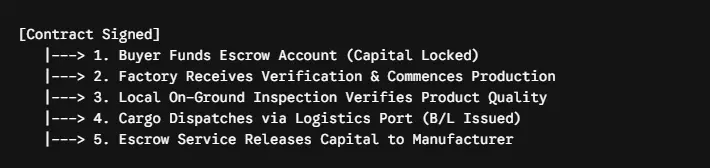
- Agreement Execution: The buyer and supplier sign an agreement defining the delivery timeline, product specifications, and quality standards, agreeing to settle via an escrow payment.
- Capital Funding: The buyer initiates a transfer to the regulated secure escrow service provider. The system notifies the factory that 100% of the milestone value is safely locked in the account.
- Safe Production: Knowing that the capital is fully secured by an official intermediary, the factory confidently purchases raw materials and schedules assembly lines without fearing sudden cancellation.
- Logistics Handover: The finished products move out of major transit hubs like Shanghai or Ningbo port. The buyer’s representation confirms product compliance and receives the necessary digital tracking files.
- Fund Release: Upon verifying the matching shipping paperwork, the escrow system dispatches the stored capital to the supplier’s commercial bank account, concluding the loop safely.
If you are looking to integrate corporate card clearing tracks into your small-batch prototype testing cycles, read our financial guide: [Credit Card Payments in International Trade: Pros and Cons]
Why Third-Party Payment Protection is Critical for Small Business Sourcing
For emerging e-commerce brands, Amazon FBA sellers, and mid-sized wholesale distributors, testing new manufacturers without a local presence can be highly risky. Utilizing third-party payment protection to unlock automated buyer protection provides a vital security net:
Deterrence of Unreliable Suppliers
When a dishonest trading shell or broker realizes your order requires an escrow payment layer, they will typically walk away from the contract. Dishonest vendors know they cannot bypass strict milestone verifications with counterfeit paperwork or substandard products, automatically filtering out potential scams.
Reliable Dispute Resolution
If an order arrives with incorrect packaging, wrong barcodes, or quantity discrepancies, the buyer can pause the clearing cycle directly inside the platform. Because the factory does not control the capital, the neutral platform arbitration team can review the inspection reports and issue a partial or full refund directly from the secure holding pool.
To ensure your company accounts stay protected from digital invoice tampering and phishing networks, review our financial safety playbook: [How to Avoid Payment Fraud When Importing from China]
The Technical Boundaries of Platform Escrow for Large Wholesale
While electronic escrow systems offer great payment security, they carry clear structural drawbacks when your corporate purchasing scales from small sample runs to multi-container wholesale procurement:
- High Percentage-Based Costs: Standard digital channels, such as Alibaba escrow, charge variable service fees ranging from 2% to 3% of the total order value. On a $50,000 container run, this introduces an extra $1,500 purely in administrative fees, eating into your net margins.
- Rigid Document-Only Arbitration: Platform dispute adjusters operate remotely and judge cases purely on uploaded documentation. They cannot physically inspect a specialized production line in a secondary manufacturing hub. If you face a complex structural or raw-material quality dispute, these rigid paper-based reviews can freeze your capital for months.
To discover how to transition away from high variable platform fees toward flat-fee bank channels without sacrificing financial safety, see: [PayPal vs Bank Transfer: Best Payment Method for International Buyers]
How Sourcing Agents Provide Ground-Level “Physical Escrow”
To bypass high variable platform fees while keeping your capital fully protected, smart importers utilize a local sourcing partner. As an established B2B sourcing expert with offices in Yiwu and Guangzhou, Union Source provides a cost-effective alternative by combining low flat-fee bank wires with direct, on-ground risk management:
- Pre-Order Vetting: Our local teams visit facilities in person to run background checks on corporate licenses, manufacturing capabilities, and legal histories before you send any deposit.
- Rigid Full-Process QC: We place dedicated quality control staff on the factory floor to run strict pre-production, mid-production, and pre-shipment inspections. We verify that your cargo is 100% accurate before it leaves the factory doors, fixing errors before any final balances clear.
- Seamless Credit Transition: As your trading volumes grow and a clean history of successful orders is established, we help you step away from upfront deposits entirely, using our commercial reputation to unlock Net 30 or Net 60 deferred credit terms through Sinosure.
Frequently Asked Questions (FAQ)
Why do large manufacturing plants resist online platform escrow payments?
Traditional factories operate on low single-digit margins. The percentage-based fees charged by online escrow platforms can consume their entire profit margin. Furthermore, manufacturers are cautious about platform policies that allow dishonest buyers to lock up factory capital or file groundless chargebacks, which leaves the supplier with unpaid raw materials.
What is the safest trigger for releasing funds from an escrow account?
The gold standard for fund release is a verified third-party inspection report combined with an official ocean Bill of Lading (B/L). Buyers should specify in the contract that the secure escrow service will release the final balance only after an independent local QC team uploads a passing pre-shipment report and the shipping line issues proof of vessel loading.
How does Union Source’s protection compare to standard digital escrow services?
Digital escrow systems act purely as financial middlemen; they never touch the cargo or visit the factory, managing disputes solely through uploaded text and photos. In contrast, Union Source provides an integrated on-ground solution combining verified fund administration, physical pre-shipment quality control, and direct port logistics, resolving product quality issues before the cargo leaves the country.
Conclusion
Building a reliable escrow payment framework is a vital strategy for protecting your capital and scaling your international supply chain securely. Whether you use an online trade escrow platform for early-stage sample testing or partner with a professional sourcing agent like Union Source for bulk container risk management, keeping control of your funds is essential. Combining secure third-party payment protection with professional, on-ground quality control ensures your cross-border sourcing operations remain secure and highly efficient.
To guarantee maximum supply chain safety, remember these core rules:
- Never issue large upfront wire transfers to unfamiliar suppliers without verified legal vetting;
- Utilize digital escrow platforms primarily for sample orders to take advantage of built-in buyer protection;
- Transition bulk wholesale shipments to flat-fee channels backed by a local quality control partner to eliminate high percentage fees;
- Tie your final payment milestones directly to a verified pre-shipment inspection report.
Building a secure global supply chain requires combining strong financial verification with rigorous, on-ground product quality milestones.
Secure Your International Trade Payments Today
Since 1997, Union Source has served as a premier one-stop B2B sourcing agent in Yiwu and Guangzhou, helping wholesale buyers across 80+ countries secure and scale their international trade pipelines. Our on-ground teams manage deep factory evaluations, complete supplier screenings, and run full-process QC inspections (pre-production, mid-production, and pre-shipment). We ensure your cargo matches your exact standards before any final wire balance is cleared.
We provide a 2-hour email response window, 24/7 telephone availability, and complete freight forwarding support out of Ningbo and Shanghai ports. Ready to optimize your trade credit and scale your importing safely?

Dujuan is a sourcing specialist at UnionSource China, experienced in global procurement, product development and supplier coordination. She focuses on helping overseas buyers find quality products with reliable service, clear communication and efficient order follow-ups.