

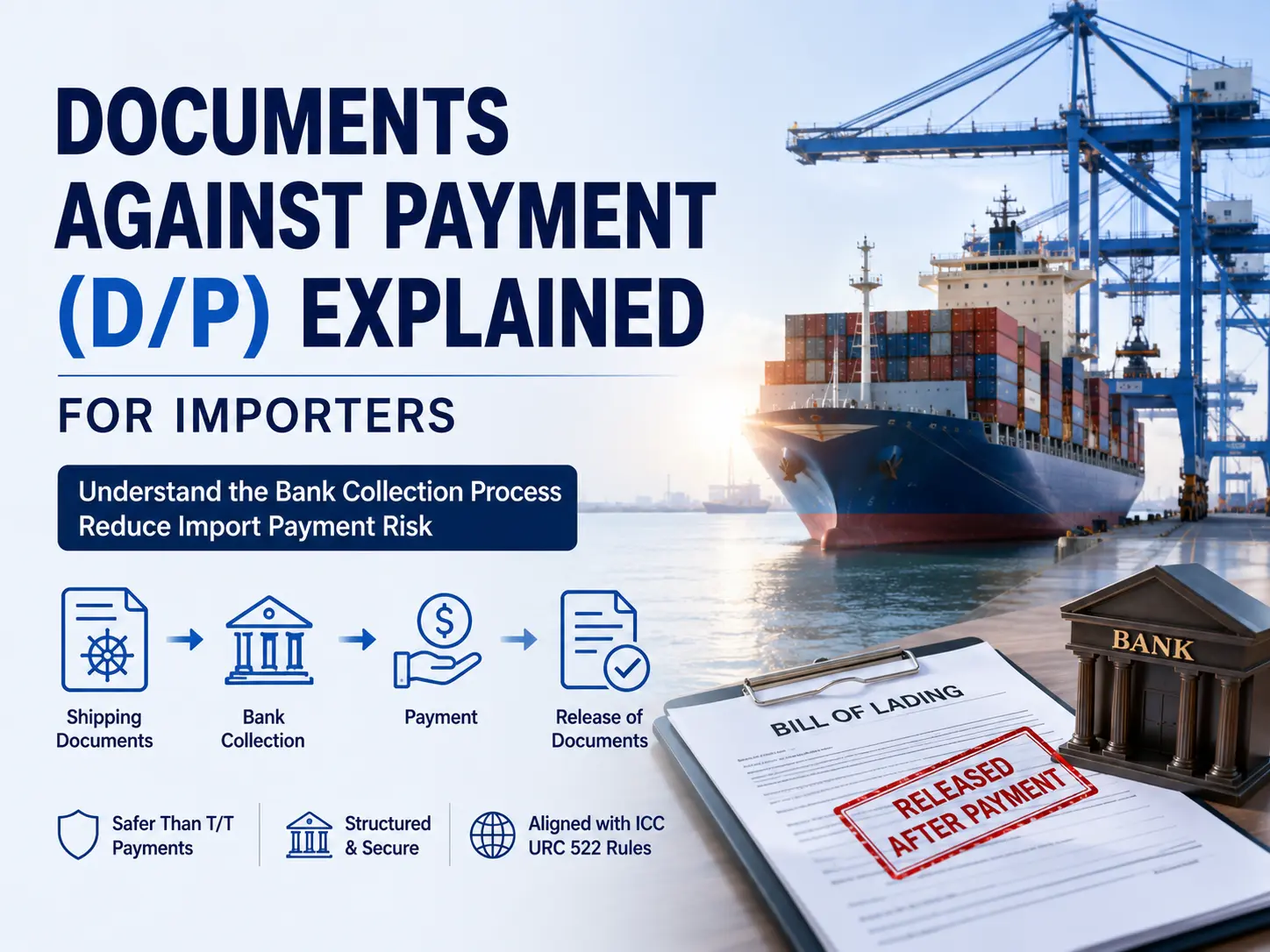
Documents Against Payment (D/P) is a documentary collection in which the collecting bank releases the documents covered by the collection instructions after the buyer pays. The banks handle documents and payment instructions; they do not guarantee that the goods meet the contract or that either party will perform. D/P can reduce a buyer’s need to pay before shipment, but it does not remove shipment, quality, or refusal risk.
For importers buying from China or other manufacturing hubs, the key question is not simply whether D/P is safer than a wire transfer. It is whether the documents, payment timing, cargo arrangements, and sales contract fit the order. The points below explain the process and the checks to make before agreeing to a collection.
Key Takeaways
- D/P terms utilize intermediary banks as financial caretakers, ensuring title documents (the Bill of Lading) are never released until cash payment is finalized.
- This framework significantly reduces the importer’s upfront risk compared to traditional T/T payments, as funds are only transferred when the goods arrive at the destination port.
- The primary risk under a documentary collection is that the cargo could face costly demurrage fees if the buyer fails to settle the bank collection swiftly.
- Sourcing agents like Union Source help protect your transactions by combining localized on-ground quality control with integrated bank financing channels.
What Does Documents Against Payment Mean?
Documents Against Payment, or D/P, is a documentary collection instruction: the exporter sends commercial and, where applicable, transport documents through banks, with instructions to release the documents to the importer against payment. The collection is handled under the rules agreed by the parties, such as the ICC Uniform Rules for Collections (URC 522) when those rules are expressly incorporated.
In a typical arrangement, the exporter ships the goods and asks its bank, the remitting bank, to forward the documents and collection instructions to a bank in the importer’s country. That bank, the collecting bank, presents the documents to the buyer and follows the instructions. It does not act as a payment guarantor or verify that the cargo matches the sales contract.
The documents may include an invoice, packing list, certificate of origin, insurance document, and bill of lading. The exact set is transaction-specific. A bill of lading’s role in taking delivery also depends on its form and the carrier’s requirements, so do not assume every transport document gives the same control over the goods.
For a broader comparison of payment options, see our guide to international payment methods for importers. For a bank’s overview of D/P terminology, see this D/P explainer.
The Step-by-Step Bank Collection Process
The D/P framework follows a strict, sequential financial and logistical chain to ensure neither party is defrauded:
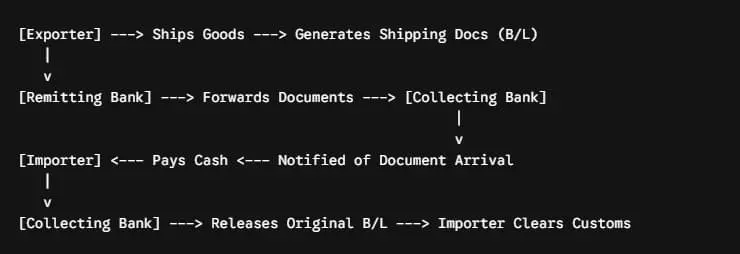
- Production & Shipment: The supplier manufactures the wholesale goods and books an ocean container through ports like Shanghai or Ningbo. Once loaded, the shipping line issues an original Bill of Lading (B/L) to the seller.
- Document Submission: The exporter gathers all essential records—including the commercial invoice, custom packing list, certificate of origin, and the original B/L—and hands them to their local financial institution (the Remitting Bank).
- Bank-to-Bank Routing: The Remitting Bank securely forwards these papers along with explicit collection instructions to your local financial institution (the Collecting Bank) near your destination port.
- Notification & Review: Your local bank notifies your procurement team that the title records have arrived safely and are ready for verification.
- Payment & Release: Your company transfers the full cash balance to the Collecting Bank. As soon as the cash clears, the bank releases the original Bill of Lading. You can then take this document to the port to clear customs and claim your cargo.
D/P vs D/A vs T/T vs L/C: Payment Method Comparison
Importers frequently confuse D/P with its close counterpart, Documents Against Acceptance (D/A), and with the two dominant methods, T/T and L/C. While D/P and D/A use identical bank routing, their financial mechanics are completely different. The table below puts all four side by side.
| Criterion | D/P | D/A | T/T (Advance) | L/C |
|---|---|---|---|---|
| When you pay | At document presentation (usually at sight) | On a fixed future date after accepting a time draft (Net 30, Net 60, etc.) | Before or during production | Bank pays the seller when complying documents are presented |
| How you get the goods | Pay the bank, then collect the B/L | Sign the draft, take the B/L immediately | Seller ships; no document gate | Pay/accept under the credit, then collect the B/L |
| Importer’s cash flow impact | Pay once, near shipment arrival | Deferred: pay weeks after receiving goods | Pay long before goods arrive | Pay per credit terms; deposit or credit line often required |
| Risk to importer | Goods not inspected by anyone before payment | Highest seller exposure; importer risk is mainly on product quality | Highest: pay a factory you may not know | Lowest for the importer: documents are strictly examined against credit terms |
| Cost | Low: bank collection fees only | Low to moderate | Negligible: wire fees only | Highest: issuance, advising, amendment and discrepancy fees |
| Ease of setup | Simple; no credit facility needed | Requires seller trust and credit history | Simplest | Complex; requires an approved L/C application and a bank credit line |
| Typical use case | Established buyers, mid-size repeat orders | Trusted long-term relationships, mature accounts | New suppliers, sample runs, small orders | Large capital orders, first transactions with unknown suppliers |
The essential difference: under D/P the bank releases documents only against cash, so it is strictly cash-on-delivery at the document level. Under D/A, you clear your cargo by signing a time draft — a legal promise to pay at a future date — which transfers far more credit risk to the supplier and is therefore harder for newer buyers to obtain.
For a deeper dive into both sides of that comparison, read our complete analyses of Documents Against Acceptance (D/A) in International Trade and TT vs LC: Which Payment Method Is Safer for Importers?
When Importers Should (and Shouldn’t) Use D/P
D/P is a tool, not a default. It works best in specific situations and fails badly in others.
Good fit for D/P:
- You have completed several successful transactions with the supplier and verified product quality, but the volume does not justify the cost of an L/C.
- Your supplier insists on payment protection after being burned by open-account buyers, and you refuse to pay 100% upfront.
- Your margins are sensitive and L/C fees plus a blocked credit line would erode them.
- Your order value is moderate — typically mid five figures and above — where banking formality is worth the fees but not an L/C’s full cost.
Poor fit for D/P:
- First orders from an unverified supplier. D/P protects the seller; it does almost nothing for you on product quality. On a first order, use T/T with a deposit or an L/C with inspection clauses instead.
- Time-critical shipments. If your goods must clear customs within hours of berthing, a document courier delay can strand the cargo at the port.
- Markets with strict currency controls. Confirm with your bank that inbound documentary collections are processed smoothly in your country before committing.
- High-variability products. For custom, fragile or quality-sensitive goods, the absence of any bank-side quality check makes D/P riskier than it looks on paper.
What Risks Should Importers Check Before Using D/P?
D/P can change when the buyer pays, but it does not remove the commercial risks of importing. Before agreeing, assess both outcomes: paying and later finding a problem with the goods, or declining to pay while the shipment is already in transit or at port.
Product quality and specification risk
Banks examine and handle documents according to the collection instructions; they do not open containers or confirm that products meet the purchase contract. A document set can be in order while the goods have defects or differ from the agreed specification. Use written specifications, approved samples, production checks, and a pre-shipment inspection where appropriate. Set out a separate process for claims and remedies in the sales contract.
Refusal, delay, and cargo costs
If the buyer does not pay, the collecting bank follows the collection instructions, which may include notifying the remitting bank and holding or handling the documents as directed. The goods’ disposition, title, and any return, resale, storage, or demurrage costs depend on the contract, transport documents, carrier terms, and applicable law. Agree in advance who will make decisions and bear costs if payment is refused or delayed.
Document and payment mismatches
Before shipment, confirm that the collection instruction names the correct buyer and presenting bank, states the payment condition and charges, and lists the documents the buyer needs to take delivery. Check that the sales contract, invoice, transport document, insurance arrangement, and collection instruction use consistent details. Ask the banks about their procedures and fees before the seller dispatches the documents.
How Can Sourcing Support Reduce Operational Risk?
A sourcing partner can help with supplier checks, production follow-up, document coordination, and quality inspections in the country of origin. These services address operational risks around a purchase; they do not replace the buyer’s bank, change the collection instruction, guarantee payment, or replace legal and banking advice.
- Check the supplier and order details. Confirm the supplier’s identity, product specifications, production capacity, and the agreed contract terms before placing the order.
- Plan quality checks before shipment. Arrange sample approval and inspections at suitable production milestones. An inspection report is useful only if its scope and acceptance criteria are agreed in advance.
- Coordinate documents and shipment information. Compare the invoice, packing list, shipment details, and required certificates against the contract and collection instructions before documents are sent to the banks.
For related guidance, see our articles on avoiding payment fraud when importing from China and understanding Net 30 and Net 60 payment terms.
Frequently Asked Questions
Can I inspect the goods before paying under D/P?
D/P describes how documents are released, not whether a buyer may inspect cargo. The collecting bank does not arrange a product inspection. Buyers commonly agree on factory inspections before shipment; access to cargo after arrival depends on the shipment, carrier, port, and local procedures. Specify inspection timing and acceptance criteria in the purchase contract.
What happens if I refuse to pay a D/P collection?
The collecting bank follows the collection instructions, which may require it to notify the remitting bank and hold or handle the documents as directed. The buyer may not receive the documents needed to take delivery. The seller and buyer must address the goods and any costs under their contract, transport documents, carrier terms, and applicable law; outcomes are not identical for every shipment.
Is D/P safer than a letter of credit?
Neither method is safer in every respect. Under D/P, banks handle documents and payment instructions but do not promise to pay. An L/C can include a bank undertaking to honor a complying presentation under its terms, but banks examine documents rather than the physical goods. Compare cost, document requirements, timing, and each party’s risks before choosing.
Do I pay only after the goods arrive at my port?
Not necessarily. D/P payment is generally due when the collecting bank presents the documents, which may happen before or around the cargo’s arrival. Transit times and document handling vary. Confirm the expected presentation date with the seller and banks and plan for the payment deadline stated in the collection instruction.
Conclusion
D/P may suit a transaction where the seller is willing to ship before receiving payment and the buyer is prepared to pay when the agreed documents are presented. It is not a quality guarantee, a bank payment guarantee, or a promise that payment will wait until the goods arrive. The contract, collection instructions, transport documents, and local rules all matter.
- Agree the payment trigger, required documents, currency, bank charges, and payment deadline before shipment.
- Arrange quality control before dispatch; bank document handling does not verify product condition.
- Confirm how the transport document works and what is needed to take delivery.
- Set out what happens if payment is delayed or refused, including responsibility for storage and other cargo costs.
Union Source supports importers with supplier coordination, production follow-up, quality inspection, and shipping document checks in China. Contact the Union Source team to discuss sourcing and shipment support for your order.

Dujuan is a sourcing specialist at UnionSource China, experienced in global procurement, product development and supplier coordination. She focuses on helping overseas buyers find quality products with reliable service, clear communication and efficient order follow-ups.