

If you source from China and ship to Southeast Asia, you already know the real bottleneck isn’t finding a supplier — it’s getting goods to market fast and at the right cost. In 2025, that equation changed. A southwest-China port quietly crossed 10 million TEUs, built direct routes to every major ASEAN port, and started cutting shippers’ transit time by 4–10 days.
That port is Beibu Gulf Port — and for importers, e-commerce sellers, and wholesalers moving cargo between China and ASEAN, it’s reshaping the cost and speed of the entire route. Read on to see how it grew, why it’s the natural gateway to Southeast Asia, and what the savings could mean for your business.
What Is Beibu Gulf Port?
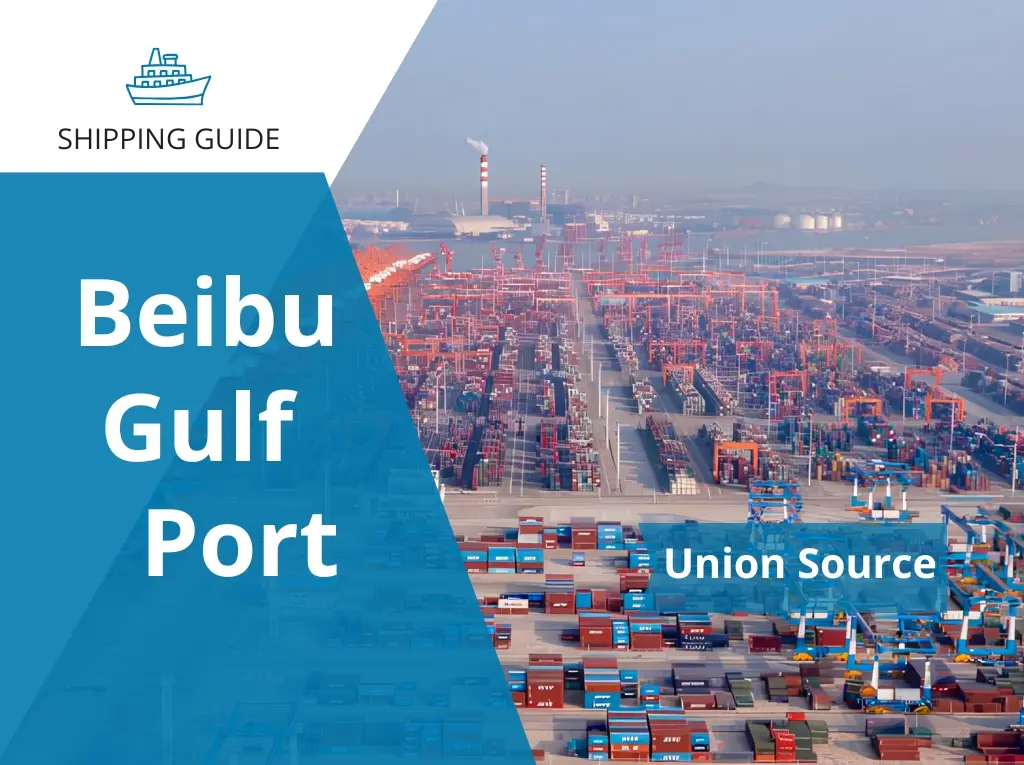
Beibu Gulf Port is a deep-water port complex in Guangxi Zhuang Autonomous Region, in southwest China. It sits on the Beibu Gulf — the arm of the South China Sea bordered by southern China and Vietnam — making Guangxi the only Chinese province that borders ASEAN by both land and sea. The complex operates 91 production berths with a comprehensive cargo throughput capacity of about 450 million tons.
The Three Port Areas
The port is a cluster of three major port areas, each with a distinct role:
- Qinzhou Port — the container and logistics core, home to automated terminals and the densest concentration of ASEAN shipping routes.
- Beihai Port — a diversified hub serving bulk, general cargo, and passenger routes.
- Fangchenggang Port — a major bulk and energy cargo gateway, handling ores, coal, grain, and petroleum.
From Regional Outpost to Mega Port: The Growth Story
Beibu Gulf Port’s rise has been remarkably swift. As recently as 2017, the port handled just 2.28 million TEUs and operated 42 shipping routes. Within eight years, it transformed into a globally connected mega port.
The 2017–2025 Leap
The turning point was the development of the New International Land-Sea Trade Corridor, a national strategy that positioned Beibu Gulf Port as the sea-going exit for China’s western inland provinces. Investment poured into berths, automation, and route networks. The results compounded year after year:
| Year | Container Throughput | Shipping Routes |
| 2017 | 2.28 million TEUs | 42 routes |
| Q1 2025 | 2.17 million TEUs (+12.06% YoY) | — |
| Full-year 2025 | Over 10 million TEUs | 100+ routes |
On December 30, 2025, the port hoisted its 10-millionth TEU of the year — a historic milestone that placed Beibu Gulf Port among the world’s top-tier container ports.
2025 Milestones
The breakout year delivered a string of records:
- 20 new container shipping routes added in 2025.
- 11 berths opened to foreign trade — a single-year high.
- The inaugural voyage of the 100th container route, linking Beibu Gulf to Kampot, Cambodia.
- The port’s first roll-on/roll-off (RoRo) service to the Persian Gulf, carrying nearly 950 Changan and LiuGong vehicles to Jebel Ali (UAE) and Dammam (Saudi Arabia).
From a peripheral outpost to a globally connected mega port in under a decade, Beibu Gulf Port’s growth trajectory shows no sign of slowing.
Why Beibu Gulf Is the Natural Gateway to Southeast Asia
Several factors make Beibu Gulf Port the most logical shipping gateway for China-to-Southeast Asia trade.
Full ASEAN Port Coverage
Beibu Gulf Port has achieved full coverage of all major ASEAN ports. The Qinzhou Port area alone operates 44 shipping routes dedicated to ASEAN countries, connecting shippers directly to Vietnam, Thailand, Indonesia, Malaysia, Cambodia, Singapore, and beyond. For a buyer sourcing goods in China for Southeast Asian distribution, that means more direct sailings, fewer transshipments, and shorter transit times.
Proximity and Network Reach
Geography is Beibu Gulf’s structural advantage. For cargo originating in southwest and central China, the sea distance to ASEAN is dramatically shorter than routing through eastern-coast ports such as Shanghai or Ningbo. The port’s 100+ container shipping routes now reach 581 ports across 127 countries and regions.
Beyond ASEAN, the network extends to the Middle East, Europe, Africa, and the Americas — so a shipment routed through Beibu Gulf can reach global markets, not just Southeast Asia.
The “R&D in China, Manufacturing in Guangxi, Assembly in ASEAN” Model
Beibu Gulf’s gateway role is reinforced by a regional industrial model — “R&D in China, manufacturing in Guangxi, assembly in ASEAN” — that has taken hold in sectors like new energy vehicles, electronics, and textiles. In 2025, exports of Guangxi-made auto parts surged 24.6% and **lithium batteries 60.7%, much of it flowing through Beibu Gulf to ASEAN assembly plants and markets.
For sourcing buyers, this means a growing cluster of export-ready manufacturers sits right behind the port — exactly the supply base that Union Source’s sourcing services help global buyers access.
The New International Land-Sea Trade Corridor
Beibu Gulf Port does not stand alone. It is the maritime anchor of the New International Land-Sea Trade Corridor — a multi-modal logistics backbone connecting China’s western inland regions to ASEAN and global markets.
Sea-Rail Intermodal Network
The corridor’s defining feature is its sea-rail intermodal integration: rail brings cargo from inland provinces to Beibu Gulf Port, where it transfers to ocean shipping. In 2025, 10,218 sea-rail intermodal trains departed from Beibu Gulf Port. The network now spans 18 provinces and municipalities, covering 75 cities and 163 stations, with intermodal volume having grown 3.5-fold since 2019.
The corridor’s rail service alone handled a record 1.425 million TEUs in 2025, up 47.6% year on year, and its broader network reached 593 ports in 128 countries and regions.
Cold-Chain Connectivity
For buyers of perishable and agricultural goods, the corridor offers specialized cold-chain routes. Guangxi has launched nine cold-chain shipping routes to ASEAN, anchored by a comprehensive cold-chain logistics base at Qinzhou Port that stores, processes, and distributes ASEAN agricultural products. This makes Beibu Gulf Port equally relevant for food, seafood, and temperature-sensitive cargo — categories where reliable cold-chain logistics can make or break a supply chain.
The Pinglu Canal: A Game-Changer for Inland-to-Sea Shipping
The single biggest development on Beibu Gulf’s horizon is the Pinglu Canal — a project poised to redraw inland China’s logistics map.
Project Snapshot
- Length: 134.2 km
- Total investment: over 70 billion yuan (~US$10.7 billion)
- Capacity: accommodates 5,000-tonne vessels
- Status: full-channel connectivity achieved in June 2026; scheduled to open to navigation in September 2026
The Pinglu Canal is China’s first major river-to-sea canal planned and coordinated at the national level since 1949. It starts at the mouth of the Pingtang River in Hengzhou, passes through Lingshan County, and runs along the Qinjiang River directly into the Beibu Gulf.
What It Changes
Once operational, the Pinglu Canal will shorten the inland waterway journey for cargo from southwest China by roughly 560 kilometers compared with the route via Guangzhou Port. For shippers, that translates directly into lower inland transport costs and faster door-to-port movement — reinforcing Beibu Gulf Port’s cost advantage for any cargo originating inland.
ASEAN diplomats have emphasized the canal’s regional significance. Singapore’s Consul-General in Guangzhou noted it would shorten transport time, reduce logistics costs, and improve trade efficiency between China’s western regions and ASEAN. The project also complements Cambodia’s Funan Techo Canal (172.6 km) and links with the China-Laos Railway, weaving Beibu Gulf into an increasingly interconnected regional transport web.
For buyers, the Pinglu Canal means that the inland-to-Beibu-Gulf leg — often the most expensive and time-consuming part of a China sourcing shipment — is about to get cheaper and faster.
Time & Cost Savings for Shippers
The practical payoff of routing through Beibu Gulf Port comes down to two numbers buyers care about most: time and money.
Faster Transit
Choosing the New International Land-Sea Trade Corridor through Beibu Gulf, compared with traditional eastern-port routing, shortens transit time by 4 to 10 days and improves transport efficiency by 10–15%. For e-commerce sellers and retailers working with tight replenishment cycles, that difference can mean avoiding stockouts during peak seasons.
Lower Logistics Costs
The same routing lowers comprehensive logistics costs by more than 8%. A real-world example: Changan Automobile now ships vehicles to the UAE via Beibu Gulf rather than eastern ports, capitalizing on the shorter, cheaper corridor.
What This Means for Union Source Customers
These savings are most valuable when shipping is integrated with sourcing from the start — which is exactly how Union Source operates. As a China-based sourcing agent in business since 1997, Union Source manages the full workflow from factory selection and product sourcing to quality control, repackaging, and freight forwarding.
For shipments routed through Beibu Gulf Port, Union Source coordinates FCL and LCL ocean freight, rail, and air options, leverages a “green channel” for China customs clearance, and can typically dispatch products within 7 days. The result: buyers get southwest-China cost and time advantages without managing multiple vendors — whether the destination is a Southeast Asian port, a Middle East hub, or beyond.
When to choose Beibu Gulf routing:
- Your suppliers are in southwest or central China.
- Your destination is an ASEAN port, the Middle East, or Indian Ocean markets.
- Your cargo is general merchandise, textiles, auto parts, electronics, or cold-chain goods.
- You want to compress inland-to-port transit and cut comprehensive logistics cost.
For buyers whose suppliers are concentrated on China’s eastern coast, ports like Ningbo may still be optimal — and Union Source’s freight team can advise on the most cost-effective routing for each order.
FAQ
How many TEUs did Beibu Gulf Port handle in 2025?
Beibu Gulf Port surpassed 10 million TEUs in container throughput in 2025, with the 10-millionth TEU hoisted on December 30, 2025 — a first in the port’s history.
Does Beibu Gulf Port connect to all ASEAN countries?
Yes. Beibu Gulf Port has achieved full coverage of all major ASEAN ports, with the Qinzhou Port area alone running 44 ASEAN-dedicated routes in 2025.
How much time and money does shipping through Beibu Gulf save?
Routing via the corridor shortens transit by 4–10 days, improves transport efficiency by 10–15%, and lowers comprehensive logistics costs by more than 8% versus traditional eastern-port routing.
When does the Pinglu Canal open?
The Pinglu Canal is scheduled to open to navigation in September 2026. It will shorten the inland waterway journey for southwest-China cargo by about 560 km compared with the Guangzhou route.
Can Union Source arrange shipping through Beibu Gulf Port?
Yes. Union Source provides end-to-end sourcing, quality control, and freight forwarding — including FCL/LCL sea, rail, and air freight routed through Beibu Gulf Port, with “green channel” customs clearance and dispatch typically within 7 days.
Conclusion
In less than a decade, Beibu Gulf Port has gone from a regional outpost to a 10-million-TEU mega port with 100+ shipping routes and full ASEAN port coverage — anchored by the New International Land-Sea Trade Corridor and soon supercharged by the Pinglu Canal. For anyone sourcing products in China and shipping to Southeast Asia, it offers a rare combination of shorter transit, lower costs, and direct ASEAN connectivity.
Sourcing products to ship to Southeast Asia? Contact Union Source for end-to-end sourcing, QC, and logistics support that puts Beibu Gulf Port’s cost and time savings to work for your business.

Zack, Marketing Manager at Union Source, brings years of experience in global sourcing and market strategy. Zack focuses on analyzing market trends and sharing practical insights that help international buyers and business partners stay ahead in the fast-changing world of wholesale trade.