

The Canton Fair has been piloting ESG certification since 2023, and the Spring Canton Fair (135th edition) in 2025 has made ESG a prerequisite for entry into the “Sustainable Development Zone.”
For buyers aiming to discover high-quality suppliers while exploring the new Sustainable Development Zone, our Canton Fair 2025 Spring guide to premium wholesale products highlights the must-visit sections and sourcing tips.
As of the Canton Fair 2025, participating enterprises’ ESG certifications follow a”official grading + international standards” dual-track system; the following types of certifications have become key focal points for international buyers due to their strong credibility and high recognition (with identification methods and value comparison attached):
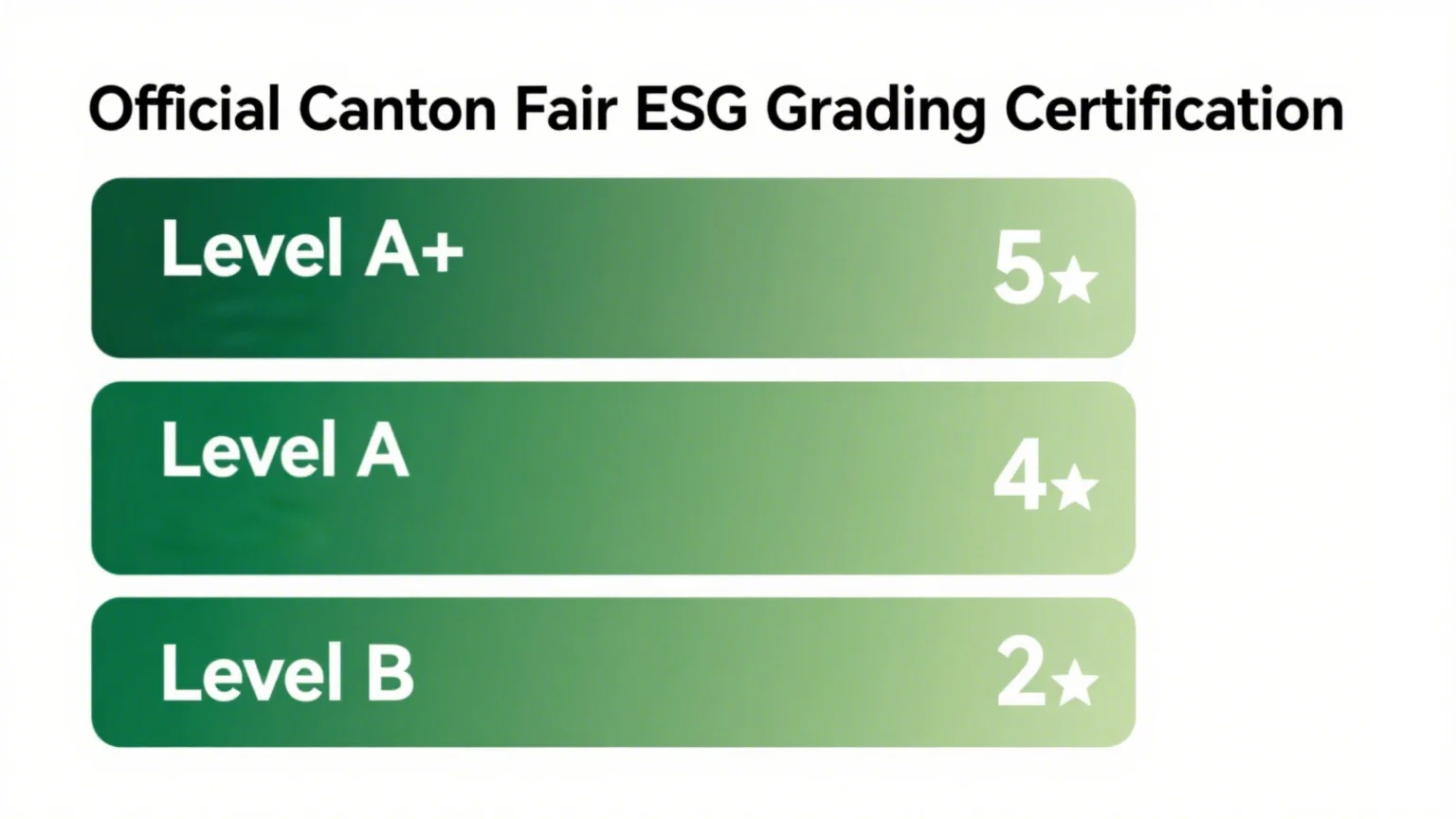
I.Official Canton Fair ESG Grading Certification (Highest Priority)
Level A+
Core data such as carbon emissions have been verified by Shanghai Environment Exchange/Guangzhou Carbon Exchange and the ESG report complies with the EU CSRD standards
⭐⭐⭐⭐⭐ (Recognized by over 90% of cross-border buyers)
Level A
Audited by designated Canton Fair institutions such as SGS and BV, covering scope 1 & 2 emissions
⭐⭐⭐⭐ (80% buyer credibility)
Level B
Self-declaration + basic document certification (e.g., pollution discharge permit)
⭐⭐ (Reference for small and medium-sized buyers only)
Identification Method:Anti-counterfeiting QR code copper plaque (scan to verify authenticity via the Canton Fair ESG database)
II. International Authority Certifications (Essential for Exporting to the EU)
1. Science Based Targets Initiative (SBTi)
Applicable Enterprises: Annual revenue > 500 million or emissions > 50,000 tons CO₂
Advantage: Major buyers like Walmart and Apple mandate that the Canton Fair A+ certification can offset 50% of the audit requirements
On-site verification: Requires displaying the SBTi official approval letter (project number can be verified)
2. CDP climate questionnaire rating
Recognition level: A/A- grade (only 12% of companies globally received A in 2025)
Bonus points: If the supply chain module score is above Class B (proving scope 3 emission control)
3. ISO 14064-1:2018 (Greenhouse Gas Verification)
Golden combination: Paired with ISO 14067 (Product Carbon Footprint) + ISO 50001 (Energy Management)
Buyer’s note: Need to confirm if the certification body is an IAF member (e.g., DNV, TÜV SÜD)
III. Industry-Specific Certifications
1. Manufacturing (Electronics, Mechanics)
EPEAT (Electronic Products Environmental Assessment)
Silver or higher can meet U.S. Federal Government Procurement Standards
TfS (Sustainable Chemistry Initiative)
Core certification for chemical suppliers entering the EU market
2. Consumer goods (textiles, home)
GOTS 7.0 (Organic Textile Standard)
New 2025 regulations require tracing recycled fiber supply chain carbon data
FSC forest certification
Essential for wood product companies, IKEA, Home Depot, etc. require 100% certified raw materials

IV. High-value-for-money choice for Chinese enterprises
1. Green Factory (MIIT) Domestic central enterprise procurement, local government projects
2. Carbon Label Japan, South Korea, Southeast Asia orders (scan to view carbon footprint)
3. Ecovadis Silver Award Meeting Walmart, Amazon basic requirements
V. 2025 New Trends: Certification Combination Strategy
1. EU Market: SBTi + CSRD report + EPR registration number (Extended Producer Responsibility)
2. US Market: CDP A-grade + ESG SEC disclosure (compliant with new US SEC regulations)
3. Emerging Markets: Canton Fair A-grade + Industry Carbon Labeling (e.g., CTPAS certification for home appliances)
VI. How can buyers verify carbon emission claims on-site?
✅ Prioritize reliance (audit evidence chain is complete)
ISO certificate with audit report number (e.g., ISO 14064-1:2018-CNAS-XXX)
CDP response page, labeled “Public Score Approval Date”
Screenshot of the organization’s dedicated page on the SBTi website (including target status: Committed/Approved)
❗ Exercise caution in the following situations (greenwashing risk exists)
Only the company’s self-declared “Carbon Neutrality Certificate” (no third-party audit/PAS 2060 standard)
One-time carbon offset certificate (does not reflect annual emission reduction continuous actions)
ESG report does not cover major subsidiaries (boundary missing >30%)
Operation Method:When you are on-site at the exhibition or communicating with suppliers, if you want to quickly understand whether the company’s ESG situation meets international standards, you can use the cross-border green code scanning function of the Canton Fair digital platform or Canton Fair APP. Just scan the company’s ESG certificate QR code with your phone, and the Canton Fair APP can automatically compare the gaps in the disclosure requirements of the EU CSRD (Corporate Sustainability Reporting Directive, Corporate Sustainability Reporting Directive) / U.S. SEC (U.S. Securities and Exchange Commission, U.S. Securities and Exchange Commission).
To maximize efficiency, learn how to leverage the upgraded Canton Fair 2025 digital ecosystem for seamless B2B sourcing, ensuring you track certifications and verify supplier data in real time.
By 2025’s Canton Fair, leading suppliers have generally offered carbon-neutral logistics solutions, but the depth of service and certification transparency vary significantly. Below are the key information and selection guidelines:
Four-tier service levels (sorted by emission reduction substance)
| Level | Solution types | Certification Requirements |
| L4 full-chain carbon neutrality | Transportation + Storage + Packaging Full-Process Net-Zero | SBTi Logistics Goals + PAS 2060 Carbon Neutrality Certification (90%+ Emission Reduction) |
| L3 Green Transportation | Maritime/Land Transport Low-Carbon Alternatives | IRU Green Cargo Label / IMO Ship Energy Efficiency Certification(40%-70%) |
| L2 Carbon Offsetting Basic Version | Purchase carbon credits to offset transportation emissions | Voluntary Carbon Standard (VCS) project purchase certificate |
| L1 No substantive actions | Claimed but unverified | —— |
In international trade, buyers are increasingly valuing suppliers’ sustainability capabilities and the authenticity of related data. To help buyers quickly and accurately verify suppliers’ ESG-related information on-site, the following “On-site Three-Step Verification Method” operating guide is formulated.
Step 1: Verification of Certification
Requirement to present specific certificates
First, the buyer should request the supplier to present a PAS 2060 carbon neutrality certificate, and this certificate must include the logistics module. PAS 2060 is the world’s first carbon neutrality standard, covering requirements for the achievement, verification, and declaration of carbon neutrality. A certificate that includes the logistics module can more comprehensively reflect a company’s carbon neutrality efforts throughout the product lifecycle, particularly in the logistics operations, and serves as an important credential for measuring the green environmental level of a company’s logistics operations.
Verification of the issuing organization’s qualifications
After obtaining the certificate, it is necessary to verify the qualifications of the issuing organization. The specific procedure is to log in to the official website of the National Certification and Accreditation Administration Commission (CNCA) for the query. Only certificates issued by issuing organizations that can be found in CNCA possess authority and credibility, effectively preventing suppliers from using false or non-compliant certificates to mislead buyers, and ensuring the authenticity and reliability of certification information.
Step 2: Calculate Costs
After understanding the carbon neutrality-related certifications of the supplier, the buyer also needs to calculate the costs of different emission reduction plans to strike a balance between cost and environmental effectiveness. Below is the cost information for common emission reduction plans:
| Plan Type | Premium margin | Carbon emission reduction costs |
| Biofuel maritime transport | +15%-25% | $80-120 / ton CO₂ |
| Electric truck short-haul | +8%-12% | $40-60 / ton CO₂ |
| Carbon credit offsetting | +3%-5% | $10-30 / ton CO₂ |
Buyers can calculate the corresponding increase in costs and carbon reduction costs based on their own cost budgets and carbon reduction requirements, combined with the emission reduction programs adopted by suppliers, and thus evaluate the cost-effectiveness of cooperation with the supplier. For example, if the supplier mainly adopts bio-fuel shipping for emission reduction, buyers need to consider the impact of a 15%-25% premium and a carbon reduction cost of $80-120 per ton CO₂ on the overall procurement cost.
Step 3: Verify Data
To further verify the authenticity of carbon emission reduction data and other information provided by suppliers, buyers can operate as follows:
Go to the ESG Data Cabin at the Canton Fair (Hall 10.1), enter the bill of lading number into the data cabin’s query system. The system will automatically output the logistics information corresponding to that bill of lading, including the route, emission amount, emission reduction methods, certification body, and carbon reduction volume.

Dujuan is a sourcing specialist at UnionSource China, experienced in global procurement, product development and supplier coordination. She focuses on helping overseas buyers find quality products with reliable service, clear communication and efficient order follow-ups.