

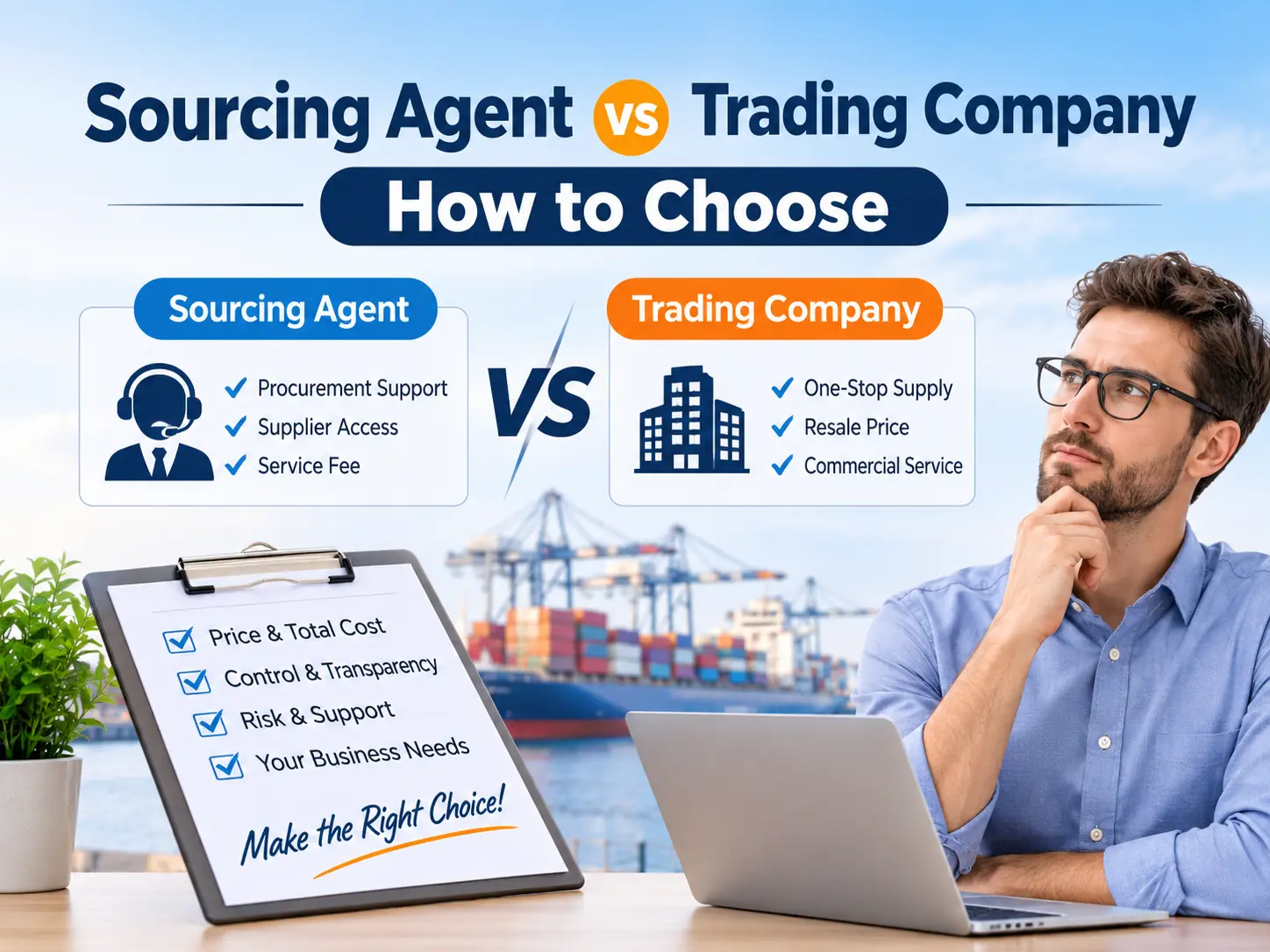
When comparing a sourcing agent vs. a trading company, start with one question: who buys and sells the goods, and who is working for you? A sourcing agent commonly arranges purchases on the buyer’s behalf for a service fee. A trading company commonly buys from a factory and resells to the buyer at an agreed price.
Those are common business models, not labels that settle every legal question. Some companies offer both. The contract, invoice, payment beneficiary, ownership of the goods, and responsibility for defects tell you more than a business card does.
What is the difference between a sourcing agent and a trading company?
A sourcing agent usually acts as the buyer’s procurement service provider. It may help identify suppliers, collect quotes, follow production, inspect goods, or arrange shipping. The buyer often purchases the goods from the supplier and pays the agent a separate fee or another agreed charge. Get the arrangement in writing.
A trading company commonly sells goods to the buyer in its own name. It may source products from one or more factories, manage quality and export, then quote a resale price. Its margin may be included in that price rather than shown as a separate commission.
Neither model guarantees a certain price, quality, or level of supplier access. An agent may agree to limited disclosure; a trading company may provide factory-level records. Some firms take either role, depending on the order. Ask who sells the goods, who receives payment, and who must resolve a shortage or defect.
How do the two models compare?
| What to compare | Sourcing agent (common model) | Trading company (common model) |
|---|---|---|
| Main role | Arranges procurement services for the buyer | Buys and resells goods to the buyer |
| Goods contract | Often between buyer and supplier; confirm the parties | Often between buyer and trading company |
| How it earns | Stated fee, commission, or service charge | Resale margin, sometimes with stated service charges |
| Supplier visibility | May be higher if disclosure is agreed | May be limited unless factory details are shared |
| Buyer workload | Can reduce local coordination; buyer approves requirements | Can simplify purchasing through one seller; buyer sets requirements |
| Often suits | Multi-supplier orders, local follow-up, inspection, or consolidation | Buyers who prefer one seller and one commercial quote |
These are typical patterns, not legal rules. A company’s role can change by product or order. Read the purchase agreement and confirm which entity will invoice you before sending money.
What changes in price, control, and risk?
Compare the full cost of receiving conforming goods, not just the unit price. An agent may list the factory price and service fee separately. A trading company may give you one resale price. Either quote can be competitive; the format alone does not tell you which costs less.
Ask both parties to quote the same specification, quantity, packaging, delivery place, and schedule. Request separate amounts for samples, tooling, inspection, inland transport, export handling, international freight, insurance, and service charges. Then compare the total landed cost using the same assumptions. Our guide to the cheapest way to buy wholesale from China explains how to compare routes on an equal basis.
Be clear about what you control. Who approves the sample and material changes? Can you contact the factory? Who appoints the inspector? Who pays if the goods fail inspection? Who controls the goods before shipment? Put the answers in the purchase order or service agreement.
An Incoterm such as FOB or DAP allocates specified delivery obligations, costs, and risks for a named place. It does not tell you whether the other party is your agent or is reselling the goods. Use the ICC’s Incoterms 2020 guidance and state the rule, named place, and version in the contract.
When should you choose a sourcing agent?
A sourcing agent may fit when you need a local team to coordinate several factories, product categories, inspections, or shipments. The value lies in the work performed and the controls you agree on, not the word “agent.” Ask for a written scope: which suppliers will it contact, what checks will it perform, what reports will you receive, how will it charge, and does it receive supplier-side compensation?
This route can help when your team has limited capacity in China or needs to combine orders from several suppliers. It may not be worth the added fee and handling for a simple order. Before deciding, request a direct-buy quote and an agent-supported quote for the same specification.
Union Source‘s sourcing service describes sourcing, order follow-up, inspection, and shipping support.
When does a trading company make more sense?
A trading company can suit buyers who want to purchase through one seller, especially when that seller can provide the needed assortment and accept clear responsibility for delivery and defects. One commercial counterparty may simplify ordering, payment administration, and claims.
There are tradeoffs. You may not see the factory’s original price, and the seller may not disclose its supplier. Ask whether products come from a manufacturer or another intermediary, whether substitutions are allowed, and what happens if a factory changes materials or misses the schedule. A seller can keep supplier relationships private and still document specifications, inspection standards, and remedies.
If factory identity matters for compliance, traceability, or repeat production, include disclosure or an independent factory audit in the agreement. Otherwise, focus on enforceable product requirements and the seller’s ability to meet them.
How can you verify which role you are dealing with?
Compare the names and responsibilities across documents before paying a deposit. A mismatch does not automatically mean fraud; a company may use an export affiliate or an authorized collection account. Ask for an explanation in writing before transferring money.
- Check the contract. Identify the legal seller and any separate service provider. Confirm the registered company name and address.
- Match the invoice. The issuer should match the contract’s seller, or the parties should explain the difference in writing.
- Verify the beneficiary. Independently confirm why the bank account belongs to another entity, if it does. Do not rely on a last-minute email alone.
- Write down ownership and risk. Confirm when the goods are considered sold, who arranges inspection, and who handles shortages or defects.
- Set the remedy. Include acceptance criteria, inspection timing, correction or replacement options, and a dispute process.
For more China-specific checks, use this supplier scam prevention checklist.
For U.S. imports, U.S. Customs and Border Protection says the importer of record remains responsible for entry accuracy and applicable duties, taxes, and fees even when a customs broker is used. An agent or trading company can coordinate documents, but agree in writing who prepares each item and have your broker confirm shipment requirements. Buyers in other markets should check their own customs authority’s rules.
Frequently asked questions
Is a sourcing agent the same as a trading company?
No. In a common arrangement, an agent provides procurement services for a fee while the buyer purchases the goods from a supplier. A trading company commonly buys goods and resells them to the buyer. Some firms do both, so identify the seller, fee arrangement, payment recipient, and defect obligations for each order.
Is it cheaper to use an agent or buy from a trading company?
Neither is always cheaper. Compare written quotes for identical goods, specifications, quantities, delivery terms, and destination. Include service fees, resale price, inspection, freight, insurance, duties, and destination charges. The lower unit price may leave out work or costs included in the other quote.
Can one company act as both an agent and a trading company?
Yes. A company may offer different transaction models. Ask it to state which role applies to your order, who sells the goods, how it is paid, and whether supplier-side payments or rebates are involved. Keep the answer with the purchase contract and invoice.
Who is responsible if the products have defects or customs problems?
The contract and applicable law determine each party’s obligations. A service agent may be responsible for the agreed service but not automatically for manufacturing defects. A trading company may be the seller, subject to its contract and governing law. Customs obligations depend on the importing country and delivery terms. Name responsible parties and remedies before ordering.
Choose by the transaction, not the label
Use a sourcing agent when the local procurement work is worth its fee and the agreement gives you the controls you need. Use a trading company when one seller’s assortment, service, and delivery commitments justify its quote. In either case, compare matching offers and write down the contracting parties, payment path, inspection plan, and remedies.
Prepare your product list, target quantity, destination, and delivery requirements, then request a sourcing quote from Union Source.

Zack, Marketing Manager at Union Source, brings years of experience in global sourcing and market strategy. Zack focuses on analyzing market trends and sharing practical insights that help international buyers and business partners stay ahead in the fast-changing world of wholesale trade.