

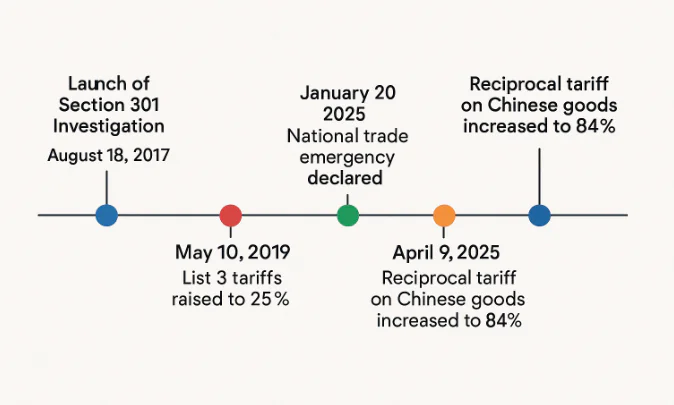
Timeline of the evolution of China-US tariff policies in recent years
According to the latest official information, the core of the current Sino-US tariff situation is a renewed threat issued by Trump in October 2025, which cast uncertainty on the phased tariff reductions agreed upon in May. In February 2025, the US imposed additional base tariffs on Chinese products and a 10% surcharge on all Chinese products (including Hong Kong). In April 2025, China and the US escalated their trade war, with the US raising tariffs on some Chinese goods to 125%. China immediately announced it would retaliate by raising tariffs on US goods to 125%. In May 2025, a phased easing of tensions led to a consensus reached in trade talks between China and the US in Geneva. The US suspended the 91% tariff increase imposed in April, retaining only the 10% surcharge for 90 days. China subsequently lifted some of its retaliatory tariffs.
In October 2025, Trump threatened to impose a 100% additional tariff on all Chinese goods exported to the US, effective November 1st. China stated it “does not want a war, but is not afraid of one,” and warned it would take corresponding measures. This new threat and confrontation has emerged, dramatically increasing uncertainty about the future. The US threat was ostensibly a response to China’s export control measures on rare earths and other related items, announced in September. Trump himself stated that he might drop his tariff threat if China lifted its rare earth export controls. A spokesperson for China’s Ministry of Commerce stated that China’s export controls are a normal step in improving its regulatory system and criticized the US for its “double standards.” China, meanwhile, reiterated its consistent position: “We do not want a war, but we are not afraid of one,” and urged the US to return to rational negotiations. Trump’s threats have triggered panic in global financial markets, leading to a sharp drop in European and American stock markets. This demonstrates the market’s strong concerns about a renewed tariff war between China and the US.
| Timeline of the evolution of China-US tariff policies | |||||
| March 2023 | August 2023 | May 2024 | August 2024 | September 2024 | October 2025 |
| China’s Ministry of Commerce calls on the US to cancel the 301 tariffs imposed on China | The WTO ruled that the US steel and aluminum tariffs violated the rules, and China demanded that the US cancel them. | US announces tariffs on $18 billion worth of Chinese goods | Additional tariffs on electric vehicles, lithium batteries and other products take effect | The United States raises tariffs on some products after the quadrennial review | Trump threatens to impose an additional 100% tariff on all Chinese goods imported into the US starting November 1 |
From 2023 to 2025, the Sino-US tariff dispute has evolved from sustained pressure to targeted escalation, and finally to the current all-out threat. The key focus in the future will be on key communications around November 1st, and whether the two sides will slide back into a full-scale trade confrontation.
When importing products from China, it is important to understand import tariffs, customs fees, and clearance documentation. As an importer, Made in China is a great option and many products can be sold locally or online at great profit. Tariffs depend on the products and goods you import into the USA from China, which makes the whole international trade process seem complicated for new importers. This article will help you understand the tariffs on goods imported into the USA from China and how to check the tariffs on each product. Let’s take an in-depth look at import duties from China to the USA.This article will allow you to learn more about import tariffs and customs clearance issues.
What is the 301 tariff policy?
Simply put, “301 tariffs” refer to additional tariffs imposed by the United States on Chinese goods imported into the United States under its domestic law (Section 301 of the Trade Act of 1974). They are the primary tool and manifestation of the Sino-US trade war. Section 301 of the Trade Act of 1974 authorizes the President to investigate foreign trade practices deemed “unfair,” “unreasonable,” or “discriminatory” and to take unilateral retaliatory measures, including tariffs, following such investigations.
The United States imposed “301 tariffs” on Chinese goods in several batches. The first round was a 25% tariff on $34 billion worth of goods on July 6, 2018. The second round was a 25% tariff on $16 billion worth of goods on August 23, 2018. The third round of tariffs was carried out in September of the same year, with a 10% tariff on $200 billion. The tariff rate was raised to 25% on May 10 of the following year. The fourth round was a 15% tariff on approximately $120 billion worth of goods on September 1, 2019, which was later reduced to 7.5%.
Regarding the 301 tariff policy, there are two key mechanisms we need to understand.
Tariff Exemption Procedure
After each round of tariff increases, the USTR has established an exemption process. American companies can apply for temporary exemptions for Chinese imports that are subject to tariff increases. These exemptions are typically valid for one year and can be extended upon expiration. As a result, we see continued extensions of exemptions for some products, while tariffs continue to be imposed on most.
(USTR stands for the Office of the United States Trade Representative. You can think of it as the U.S. Department of Trade, but it’s a very special and powerful agency. For the latest developments in Sino-U.S. tariffs, the USTR’s official website is the most authoritative and direct source.)
Four-year review system
According to US law, these additional tariffs are subject to a mandatory review four years after implementation to determine whether they should remain in place. Upon taking office, the Biden administration inherited the Trump-era tariff policy and initiated a review process. On May 14, 2024, the USTR announced that, based on the review’s findings, tariffs would be further increased, targeting strategic sectors such as electric vehicles, lithium batteries, photovoltaic cells, critical minerals, semiconductors, steel and aluminum, and medical supplies.
The “Section 301 Tariff Policy” is a long-term, large-scale, unilateral tariff measure imposed by the United States on Chinese goods imported into the United States, pursuant to its domestic law, under the pretext of “unfair trade” and “intellectual property protection.” It has become a constant factor in Sino-US economic and trade relations, remaining in effect and subject to constant adjustment through the review mechanism. It is a core manifestation of the economic and trade frictions between the two countries.

HS Coding
Customs duty is not based solely on declared value – it also varies from product to product. However, customs officers are busy people. They do not have the time to open each carton and classify it. Instead, the HS code specifies the type of product. The HS code (Harmonised Commodity Description and Coding System) is part of the international classification system and makes the process very simple.

However, you can make sure that you specify the correct HS code on your commercial invoice. Otherwise, you will end up paying customs duty rates based on the wrong product. For the correct HS code, you can look it up online at US Customs or have your clearance agent provide it to you. If you are using a customs clearance agent to help you clear customs, you should follow the customs clearance agent’s requirements.
Declared Value
Tariffs and taxes are calculated as a percentage of the customs value. The customs value is based on the declared value, which should be stated on the commercial invoice – a document issued by the supplier. It is vital that the correct value is declared on the commercial invoice, otherwise, you could end up paying the wrong amount. It is always the importer’s responsibility to ensure that the correct declared value is stated on the commercial invoice. This responsibility cannot be transferred to the Chinese supplier. You must confirm the value of all declared products with your Chinese supplier prior to shipping.
Tip. It is well known that low declarations can reduce the cost of entering goods into customs and increase the competitiveness of your products. However, customs are no fools. Every product is declared by customs when it enters the customs system based on the market price. If your goods are significantly below the price set by Customs, then the goods will be transferred directly to the inspection department by Customs, who will charge hundreds to thousands of dollars for the inspection.
What is the US import tariff rate?
To understand US tariffs on Chinese imports, it’s important to understand that they typically consist of a base tariff (most-favored-nation rate) and additional tariffs. The latter has been a key factor influencing the final tax burden in recent years. The following examples illustrate this using kitchenware (metal), home storage (plastic), and water cups (ceramic).
Kitchenware(metal)
Regarding the tariffs on kitchenware products exported to the United States under HS code 7323930000, the currently applicable total tariff rate is relatively high, primarily due to the addition of multiple additional tariffs on top of the most-favored-nation (MFN) rate.
For the steel content of the product, a 7% MFN tariff plus a 50% Section 232 tariff applies.
For the non-steel content of the product, a 7% MFN tariff plus a 10% equivalent tariff applies.
Thus, the final combined effective tariff rate will fall somewhere between these two rates, depending on the precise proportion of steel in the value of each product. Overall, the total effective tariff cost is likely to exceed 30%.
Storage(plastic)
For plastic storage products under HS code 3924100000, the final tariff is calculated as follows:
Final tariff = Most-Favoured-Nation rate + Reciprocal tariff (10%) + Other additional tariffs (if applicable).
Therefore, without considering other punitive tariffs (such as anti-dumping duties), the total tariff cost for these plastic storage products is likely to exceed 20%.
Mug(ceramic)
For ceramic mugs under HS code 6911101900, the final tariff is calculated as follows:
Final tariff = Most-Favoured-Nation tariff (7%) + Additional tariff on US goods (35%) + Reciprocal tariff (10%)
Thus, the total tariff cost for these ceramic mugs is likely to be 52%.
1)MFN – Most-Favored-Nation
This is a cornerstone principle of the World Trade Organization (WTO). Simply put, trade preferences (such as low tariffs) granted by one member country to another must be immediately and unconditionally extended to all other WTO members. These preferences are determined through multilateral trade negotiations and recorded in each country’s tariff schedule. All other additional tariffs are added on top of this rate. In the absence of any additional tariffs, this is the lowest tariff rate available in normal trade. However, it’s important to note that this isn’t “zero tariffs”; it’s simply a negotiated, relatively low base rate.
2)Imposing additional tariffs on the United States (usually referred to as “301 tariffs”)
This is an additional punitive tariff unilaterally imposed by the United States on Chinese goods exported to the United States in accordance with Section 301 of its domestic law, the Trade Act of 1974. This has been explained in detail in the above content, so I will not repeat it here.
3)Reciprocal Tariff / Universal Base Tariff
This is the core of a new tariff system proposed by Trump in 2025. It calls for a uniform, base-level additional tariff to be imposed on all products imported into the United States (except for certain exempted countries) to achieve what he calls “reciprocal trade.” While applicable to all countries, in practice, some close allies (such as those members of the USMCA) would be exempted. However, for China, this tariff would still apply. It would be layered on top of the most-favored-nation tariff rate and the “Section 301 tariff.”
Import Precautions (goods from China)
A: If it is heavy, the customs will determine that there must be a wooden package, you need to provide a fumigation certificate. If there is no wooden packaging, you must declare non-wood packaging (NON-WOOD PACKING) on all documents. Although the shipping company’s weight limit for the container is 44,000 pounds, the standard weight of the shipping company is 38,000 pounds. If the weight exceeds this weight in the US inland transportation, the truck company will require the use of its own special triangular or four-corner car frame. To ensure safe driving. In many states in the United States, this restriction is very strict and requires the transport of ultra-heavy container trucks for applications and permits. Since the cost of owning a car frame and license is extra, please note that the price is applicable to goods below 38,000 pounds when making inland-to-door service quotations. If the container exceeds 43,000 pounds, many inland states are not allowed to go on the road, and a special triangle or four-corner car frame must be used.
B: It must be labeled “Made in China” on the product. If not, Customs will require the sale of labels, especially for mass-market consumer goods, so be prepared.
C: Food.
The United States has strict import requirements for food and food-related goods. In addition to reporting customs, it is also required to declare that the FDA (FOOD & DRUG ADMINISTRATION) will release the goods before both parties can pick them up the goods. Customs agencies typically increase FDA Service fees.
D: For customs clearance inland, you need to do a customs transit (cut I.T .—Immediate Transit). We need to provide I.T. #, DATE ISSUED, PLACE ISSUED, and End. Inland Customs will use I.T # for control and release.
E: Since March 2003 U.S. Customs has been testing the AMS system. NVOCC sent it to the U.S. Customs clearance through Speedpost within 24 hours of departure. Some of the cargo NVOCC, still commissioned shipping company VOCC to do AMS. So we need to pay particular attention to who does the AMS. U.S. Customs uses only AMS numbers to identify different shipments. AMS No. includes important parts of the AMS FILER code SCAC Code. Declarations are indispensable.
F: Release the cargo.
(1) In the previous ABI system, shipping lines and terminals were directly linked to Customs, which meant that if Customs released them in ABI, shipping lines and terminals could see them. After the AMS test run, major shipping companies such as EVERGREEN, APL, MAERSK, COSCO, CSCL, etc. They were also connected to AMS, but not the terminal. Customs can therefore release an AMS. The shipping lines and NVOCC AMS FILER can be viewed simultaneously. Shipping companies help upgrade terminal systems at the same time; small shipping companies such as SINOTRANS, LYKES, and GWS. We don’t have an AMS online, so we can only fax it through NVOCC AMS FILER fax. NVOCC guarantees a letter and a customs pass (customs form 3461). These shipping companies will receive faxes and manual updates through the terminal system. As you can imagine, manual publishing can lead to a doubling of workload, as well as human error and customer data breaches.
(2) Dock/shipping company releases goods.
The docks and shipping lines are connected. If freight is paid in advance, the bill of lading will be sent by telex. Once cleared, the docks automatically hand over the goods to the truck company. In the United States, customers do not need to exchange bills of lading, so US agents cannot help detain goods. This is nothing like China.
If the shipping company’s bill of lading is sent by telex and the freight is paid in advance, the shipping company will send the freight as soon as it is received, regardless of who pays the freight. The only thing controlling delivery is the owner’s original bill of lading. SSL would not release the goods without the original bill of lading.
All trucks going to the docker must sign agreements (exchange agreements) with shipping companies and docks. Guaranteed to bear the loss and demurrage fee box. Otherwise, trucking companies and docks won’t put cabinets on trucks.
3) Inland release.
For inland cargo, after customs clearance, the freight company will give a PICKUPnumber, the agent will get the PICKUP number and notify C /, and the truck company will then use that number to pick up the cargo.
How to get Pick UP number?
A: The goods arrived and were unloaded.
B: After the customs release, the freight company can pick up the goods. If anyone of them is missing, it will not be available.
AMS IC and VSSL ARRIVAL
VSSL ARRIVAL: Notify Customs the day the ship arrives at the port of destination. This is based on an actual port of arrival and does not count the situation at the previous port of arrival.
AMS IC: After customs clearance, the AMS system will automatically display clearance information, indicating customs clearance. Almost all goods destined for the port can be declared before the arrival of the ship and the customs clearance results can be displayed. While many inland goods can be used for PRE-CLEAR, freight companies need to know if they will be released on arrival. After AMS, many NVOCCs forgot about ARRIVALI.T, which resulted in the goods not being released after customs clearance.
Customs Fines

If the customs duties are not paid on time, the customs will impose a fine with interest. Goods must be declared to customs within 15 days. If there is still no one to report to the customs after 15 days, the customs will question the safety of the goods and transfer the goods to the supervision warehouse ( GO WAREHOUSE) Unloading to inspect the container. At this time, clearance needs to be made through a supervision number (GONO). If goods enter a supervision warehouse (O.WHSE-General Order). The following costs would arise.
1. Demurrage fee or railway Demurrage fee.
2. The cabinet fee and returning cabinet fee
3. Warehouse decommissioning fee and loading fee.
4. Warehouse storage fee. Container costs.
Only pay these fees and pay the shipping fee to the shipping company in exchange for the LIEN notice to pick up the goods. If the customs formalities have not been completed within six months, the customs shall confiscate them and auction them off against the storage expenses.
Free Storage Period for Docks
The storage period at most terminals is five days (from the time the container is hoisted from the ship and from the time it is picked up). Note, after the free period, you have to pay the storage fee for holidays and weekends. Rickmers’ Houston dock has only a three-day free period.
Demurrage Fees
No matter where the cargoes come from, you usually pay $60 a day for the first five days at the terminal, then $120 a day. However, for terminals such as Hanjin and COSCO, the overdue demurrage fee is US $100 / day PER CTNR. Shipping companies and docks are different companies. Demurrage charges will be charged if the goods are not picked up after five days. If it is the responsibility of the shipping company, the terminal will charge the shipping company according to the agreement. If the shipping company does not, the terminal will charge the extractor fee.
Remarks: Shipping companies have no control over demurrage charges at terminals. That doesn’t mean shipping companies are exempt from demurrage charges, but it can help with discounts or cover some demurrage. However, particular areas, such as SAVANNAH, CSCL, and docks have long-term contracts, so they have more room to control demurrage charges.
Summary
Through this comprehensive tariff guide, our goal is to enable you to not only “understand” the rules, but also “manage” the process, so that you can make accurate decisions, effectively manage risks, and protect your business interests in this challenging trade environment.

Dujuan is a sourcing specialist at UnionSource China, experienced in global procurement, product development and supplier coordination. She focuses on helping overseas buyers find quality products with reliable service, clear communication and efficient order follow-ups.